Number Theory
Incommensurable Numbers
Aristotle, Prior Analytics I. 23 (41a23–27)
For all who draw a conclusion per impossibile2 first infer, by syllogistic reasoning, a false proposition, and then demonstrate their original conclusion ex hypothesi, when something impossible results from the assumption of the contradictory [of this conclusion]. For example, they prove that the diagonal [of the square] is incommensurable [with the side] by showing that on the assumption that it is commensurable odd numbers are equal to even numbers.
The proof referred to by Aristotle is found in Euclid, Elements X, Appendix 27, a late interpolation there according to the editor, J. L. Heiberg. The proof may be briefly paraphrased as follows:
Let ABCD be a square with diagonal AC and side AB.
If AC is commensurable with AB, the ratio AC:AB may be represented by m:n, where m and n are integers prime to each other3 and

since

Then

and

But

Therefore

whence
m is even and
n is odd.
Since m is even, let


Therefore n is even.
Since the assumption that AC is commensurable with AB leads to the impossible conclusion that the same number (n) is both odd and even, the assumption must be false.
Therefore AC is not commensurable with AB.1
Plato, Theaetetus 147 D
Theodorus2 was writing something for us about square roots, showing that the root of three [square] feet or five [square] feet is incommensurable in length with the one-foot length. And he took up the cases, one by one, until that of seventeen [square] feet. There, for some reason, he stopped. Now a thought occurred to us that since square roots of this kind seemed unlimited in number we should try to include them in one class by which we might designate them all.
THE GENERAL THEORY OF PROPORTION AND THE THEORY OF INCOMMENSURABLE MAGNITUDES
Euclid, Elements V, Definitions 4, 5; X, Definitions and Propositions 1–3. Translation of T. L. Heath, The Thirteen Books of Euclid’s Elements
V. Def. 4. Magnitudes are said to have a ratio to one another which are capable, when multiplied, of exceeding one another.
Def. 5. Magnitudes are said to be in the same ratio, the first to the second and the third to the fourth, when, if any equimultiples whatever be taken of the first and third, and any equimultiples whatever of the second and fourth, the former equimultiples alike exceed, are alike equal to, or alike fall short of, the latter equimultiples respectively taken in corresponding order.1
X. Definitions
1. Those magnitudes are said to be commensurable which are measured by the same measure, and those incommensurable which cannot have any common measure.
2. Straight lines are commensurable in square when the squares on them are measured by the same area, and incommensurable in square when the squares on them cannot possibly have any area as a common measure.
3. With these hypotheses, it is proved that there exist straight lines infinite in multitude which are commensurable and incommensurable respectively, some in length only, and others in square also, with an assigned straight line. Let then the assigned straight line be called rational, and those straight lines which are commensurable with it, whether in length and in square or in square only, rational, but those which are incommensurable with it irrational.2
4. And let the square on the assigned straight line be called rational and those areas which are commensurable with it rational, but those which are incommensurable with it irrational, and the straight lines which produce them irrational, that is, in case the areas are squares, the sides themselves, but in case they are any other rectilineal figures, the straight lines on which are described squares equal to them.1
Proposition 1
Two unequal magnitudes being set out, if from the greater there be subtracted a magnitude greater than its half, and from that which is left a magnitude greater than its half, and if this process be repeated continually, there will be left some magnitude which will be less than the lesser magnitude set out.2
Let AB, C be two unequal magnitudes of which AB is the greater: I say that, if from AB there be subtracted a magnitude greater than its
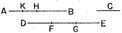
half, and from that which is left a magnitude greater than its half, and if this process be repeated continually, there will be left some magnitude which will be less than the magnitude
C.
For C if multiplied will sometime be greater than AB.
[cf. V. Def. 4]
Let it be multiplied, and let DE be a multiple of C, and greater than AB; let DE be divided into the parts DF, FG, GE equal to C, from AB let there be subtracted BH greater than its half, and, from AH, HK greater than its half, and let this process be repeated continually until the divisions in AB are equal in multitude with the divisions in DE.
Let, then, AK, KH, HB be divisions which are equal in multitude with DF, FG, GE.
Now, since DE is greater than AB,
and from DE there has been subtracted EG less than its half,
and, from AB, BH greater than its half,
therefore the remainder GD is greater than the remainder HA.
And, since GD is greater than HA,
and there has been subtracted, from GD, the half GF,
and, from HA, HK greater than its half,
therefore the remainder DF is greater than the remainder AK.
But DF is equal to C;
therefore C is also greater than AK.
Therefore AK is less than C.
Therefore there is left of the magnitude AB the magnitude AK which is less than the lesser magnitude set out, namely, C. Q.E.D.
And the theorem can be similarly proved even if the parts subtracted be halves.
Proposition 2
If, when the less of two unequal magnitudes is continually subtracted in turn from the greater, that which is left never measures the one before it, the magnitudes will be incommensurable.1
For, there being two unequal magnitudes AB, CD, and AB being the less, when the less is continually subtracted in turn from the greater, let that which is left over never measure the one before it;
I say that the magnitudes AB, CD are incommensurable.
For. if they are commensurable, some magnitude will measure them.
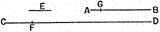
Let a magnitude measure them, if possible, and let it be E; let AB, measuring FD, leave CF less than itself, let CF measuring BG, leave AG less than itself, and let this process be repeated continually, until there is left some magnitude which is less than E.
Suppose this done, and let there be left AG less than E.
Then, since E measures AB, while AB measures DF,
therefore E will also measure FD.
But it measures the whole CD also;
therefore it will also measure the remainder CF.
But CF measures BG;
therefore E also measures BG.
But it measures the whole AB also;
therefore it will also measure the remainder AG, the greater the less: which is impossible.
Therefore no magnitude will measure the magnitudes AB, CD; therefore the magnitudes AB, CD are incommensurable. [X. Def. 1]
Therefore, etc.
Proposition 3
Given two commensurable magnitudes, to find their greatest common measure.1
Let the two given commensurable magnitudes be AB, CD of which AB is the less;
thus it is required to find the greatest common measure of AB, CD.
Now the magnitude AB either measures CD or it does not.
If then it measures it—and it measures itself also—AB is a common measure of AB, CD.
And it is manifest that it is also the greatest; for a greater magnitude than the magnitude AB will not measure AB.
Next, let AB not measure CD.
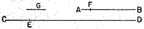
Then, if the less be continually subtracted in turn from the greater, that which is left over will sometime measure the one before it, because
AB,
CD are not incommensurable; [cf. X. 2]
let AB, measuring ED, leave EC less than itself,
let EC, measuring FB, leave AF less than itself,
and let AF measure CE.
Since, then, AF measures CE,
while CE measures FB,
therefore AF will also measure FB.
But it measures itself also;
therefore AF will also measure the whole AB.
But AB measures DE;
therefore AF will also measure ED.
But it measures CE also;
therefore it also measures the whole CD.
Therefore AF is a common measure of AB, CD.
I say next that it is also the greatest.
For, if not, there will be some magnitude greater than AF which will measure AB, CD.
Let it be G.
Since then G measures AB,
while AB measures ED,
therefore G will also measure ED.
But it measures the whole CD also;
therefore G will also measure the remainder CE.
But CE measures FB;
therefore G will also measure FB.
But it measures the whole AB also,
and it will therefore measure the remainder AF, the greater the less: which is impossible.
Therefore no magnitude greater than AF will measure AB, CD; therefore AF is the greatest common measure of AB, CD.
Therefore the greatest common measure of the two given commensurable magnitudes AB, CD has been found. Q.E.D.
2 The reference is to proof by reductio ad absurdum.
3 I.e., the fraction m/n is reduced to its lowest terms.
1 It is not certain how and when incommensurability and irrationality were first discovered. But the contrast between such a discovery and the mere approximation to the value of a surd is a contrast between night and day, (Even in the Old Babylonian period an approximation to

correct to six decimal places is said to have been attained.)
It has been suggested by K. yon Fritz (Annals of Mathematics, 1945, p. 257) that Hippasus of Metapontum (ca. 450 B.C.) may have obtained the clue from a consideration of the side and diameter of the regular pentagon. Again, the first proofs probably lacked the refinement of that reproduced above. But in any case the discovery was of momentous significance in the history of mathematics. Having discovered the numerical relations of musical intervals and of other natural phenomena, the early Pythagoreans went on to assume the sufficiency of numbers to express all relations and considered basic reality to be number (cf. Philolaus Frag. 13 [Diels] and Aristotle, Metaphysics 1090a20–25.) That no whole number or rational fraction can describe the ratio, e.g., between the diagonal and the side of a square, or of a pentagon, thus offered a crucial difficulty. Tradition records the consternation of the Pythagoreans and their attempts to suppress the discovery. Later the proof of the incommensurability of

. . . up to

indicated the existence of a whole class of incommensurabtes. And yet, lines describable as

etc., could readily be constructed geometrically. This fact naturally caused mathematicians to prefer geometric methods, which could deal with continuous geometric magnitudes such as lines, areas, and the like. The discrete series of rational numbers had proved insufficient. This may in part account for the geometrical coloring that the theory of numbers receives in Plato, Euclid, and their successors. In fact, from the prevailing Greek viewpoint the subject of the incommensurable is part of geometry rather than of arithmetic and applies to the relation of magnitudes, not of numbers; from this viewpoint arithmetic proper deals only with rational numbers. By developing a theory of surds or irrationals as "real" numbers, modern mathematics has introduced continuity into arithmetic and has justified the previous practical use of the irrationals. The ancients arrived at somewhat similar results by elaborating a theory of proportion that was applicable to incommensurable as well as commensurable magnitudes. This development began soon after the discovery of incommensurability, was carried forward with great success by Theaetetus, and brought to perfection by Eudoxus. It may be noted that the geometric theory of proportion, in which geometric ratios take the place of "real" numbers, enables one to equate two variables whose limits are equal and is at the basis of the method of exhaustion so effectively used by Eudoxus and Archimedes (see pp. 45, 60).
2 Theodorus of Cyrene, said to have been a pupil of Protagoras and a teacher of Plato, may have been the first to prove the incommensurability of

His method may have been analogous to that used for

1 There is a tradition that this definition and the theory based on it, as developed in Book V, is the work of Eudoxus. Indicative of the importance of this definition is the fact that it is essentially the same as that used in modern mathematics (see T. L. Heath, The Thirteen Books of Euclid’s Elements II. 125). On the crisis in mathematics that elicited the new theory, see p. 14, n. 1, above. Cf. the purely arithmetic definition (Euclid, Elements VII, Def. 21): "Numbers are in proportion when the first is the same multiple or part or parts of the second as the third is of the fourth."
As for Book X, much of the material was probably worked out by Theaetetus on the basis of an older definition of proportionality adapted so as to be applicable to incommensurable magnitudes. (The definition is referred to by Aristotle, Topica 158b32.) But in the form in which Euclid gives them, the proofs are probably patterned on those of Eudoxus. In fact some of the propositions are entirely dependent on this new definition of Eudoxus. [Edd.]
2 . . . The relativity of the terms rational and irrational is well brought out in this definition. We may set out any straight line and call it rational, and it is then with reference to this assumed rational straight line that others are called rational or irrational.
We should carefully note that the signification of rational in Euclid is wider than in our terminology. With him, not only is a straight line commensurable in length with a rational straight line rational, but a straight line is rational which is commensurable with a rational straight line in square only. That is, if ρ is a rational straight line, not only is (m/n)ρ rational, where m, n are integers and m/n in its lowest terms is not square, but

is
rational also. We should in this case call

irrational. . . .
[In the course of Book X there is an elaborate classification of various types of irrationals called medials, apotomes, and binomials. The attempts of early algebraists to reduce all these types to algebra considerably influenced the development of the latter subject. Edd.]
1 As applied to areas, the terms rational and irrational have, on the other hand, the same sense with Euclid as we should attach to them. . . .
2 This proposition is used in the method of exhaustion (see, e.g., Euclid, Elements XII, Prop. 2, p. 46, below). Note, in this connection, Aristotle, Physics 266b2: "if continual additions be made to a finite quantity, any given quantity will be exceeded; similarly, if continual subtractions be made the remainder may be made less than any given quantity" (where, however, there is no provision against an infinite converging series), and 207b10 "a magnitude may be bisected endlessly," as well as the so-called Axiom of Archimedes "the excess by which the greater of (two) unequal areas exceeds the less can, by being added to itself, be made to exceed any given finite area" (see p. 75, below). [Edd.]
1 This proposition states the test for incommensurable magnitudes, founded on the usual operation for finding the greatest common measure. The sign of the incommensurability of two magnitudes is that this operation never comes to an end, while the successive remainders become smaller and smaller until they are less than any assigned magnitude. . . .
1 This proposition for two commensurable magnitudes is, mutatis mutandis, exactly the same as VII. 2 for numbers. We have the process

where c is equal to rd and therefore there is no remainder.
It is then proved that d is a common measure of a, b; and next, by a reductio ad absurdum, that it is the greatest common measure, since any common measure must measure d, and no magnitude greater than d can measure d. . . .
[This procedure is sometimes called "the Euclidean algorithm." In this connection we may note, from VII, Prop. 1, the test for numbers prime to each other, viz., that in the process described above

and the process does not end until the remainder is unity. Edd.]