|
|
A Source Book in Chemistry, 1400-1900
Contents:
Show Summary
Hide Summary
General SummaryIN 1850 the type theory of organic structure had forced the older idea of radicals into the background. At almost the same time, however, Kolbe had electrolyzed potassium acetate (1849) and produced a gas which he called "the free methyl radical" (really ethane). During the next few years, Edward Frankland isolated a number of hydrocarbons which he believed to be free radicals, although these were actually saturated hydrocarbons with twice the molecular weight of the assumed radicals. Under these circumstances, Kolbe modified the type theory by recognizing the individuality of the radicals which entered into the type (the "newer type theory"). Kolbe continued to use equivalents instead of atomic weights until 1870, and therefore he wrote methyl as and in fact, wherever we now write C, he wrote [figure table] as an inseparable unit. Thus his formulas at first glance appear strange, yet he gradually built up a method of writing them which embodied most of the essentials of the modern structural system and which permitred him to explain reactions and predict new compounds almost as easily as can be done today. Unfortunately, he seldom accepted the views of other investigators and bitterly criticized the much simpler formulas of Kekulé when they were introduced. Kolbe’s work, however, was a great advance in explaining the true nature of organic compounds.The selections given below illustrate three stages in the development of his ideas. The first shows his recognition of the essential nature of the acetyl group as [figure table] united to oxygen or other atoms, although he expressed this union in terms of the copula theory of Berzelius. In the second selection he shows that carboxylic acids can be considered as derivatives of carbonic acid (which he wrote [figure table] in which a hydrogen and two equivalents of oxygen are replaced by an alkyl radical. In conformity with this, he wrote acetic acid as [figure table] This is actually a recognition of the existence of a special group, carboxyl, in the fatty acids. Since he recognized the difference of the oxygen in the HO group from that in the [figure table] group, he was able to explain the occurrence of aldehydes and ketones and still later, as shown in the third selection, to explain the nature of alcohols and predict the existence and properties of secondary and tertiary alcohols. These substances were prepared soon afterward by Charles Friedel (1832–1899) and Alexander Butlerov (1828–1886).In the selection below, Kolbe explains the nature of alcohols and predicts the existence and properties of secondary and tertiary alcohols.
Hermann Kolbe
The Natural Relation of Organic and Inorganic Compounds, the Scientific Basis for a Natural Classification of Organic Chemical Bodies4
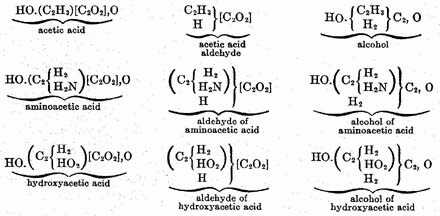
If we consider the formula by which I have previously expressed the rational composition of acetic acid, the aldehyde related to it, and alcohol, namely,
[figure table]
we immediately see how it happens that of the five hydrogen atoms in the ethyl oxide of the alcohol, when the latter is oxidized, only two atoms of hydrogen, and in aldehyde only one atom of hydrogen, are substituted. Only the independent hydrogen atoms in alcohol and aldehyde undergo the oxidizing effect, and they serve much more easily as the points of attack for the oxygen than do the other hydrogen atoms which are more firmly held in the methyl radical.
This explanation of the chemical constitution of alcohols opens for us the possibility of the discovery of new, still unknown alcohols, as well as a new class of bodies which, closely related to the alcohols in composition, can share many properties with them, yet in many obvious ways must have different properties.
As soon as we have the means of changing all alcohol acids into aldehydes and alcohols by direct introduction of one or two atoms of hydrogen in the place of even as much as one oxygen atom, we will obviously also succeed in obtaining from these acids aldehydes and alcohols which, like amino acetic acid, hydroxyacetic acid, etc., are simple derivatives of the primary acid. The relations in composition of the formulas concerned will best illustrate these similarities (see these Annals,109, 267).
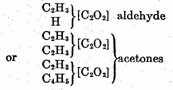
If, in an aldehyde, the independent hydrogen atom is replaced by a compound radical, there result acetones:
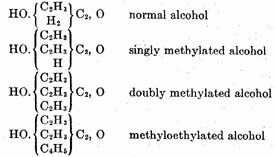
If we consider that in a similar way one or two of the two independent hydrogen atoms in the alcohol are substituted by as many methyl, ethyl, etc., atoms, there result new alcohollike compounds of the following composition:
The singly methylated alcohol is only an isomer, not identical with propyl alcohol:
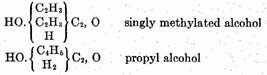
In the same way the doubly methylated alcohol has the same number of elements as butyl alcohol:
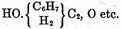
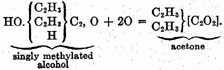
Even though none of these alcoholic compounds has been prepared up to now, I feel sure of their existence and believe that as soon as we begin experimental work in this matter, their discovery will not long be delayed. Their chemical properties can already be predicted in many ways. These bodies, like the normal alcohols, will obviously yield halogen compounds analogous to ethyl chloride with the hydrogen acids and, similarly, will give rise to sulfur compounds and mercaptans and, with sulfuric acid, to compounds analogous to ethyl sulfuric acid; but no sort of doubly methylated alcoholic compound bodies can be converted by means of oxidation into aldehydes and acids like normal alcohols, since they lack the two independent hydrogen atoms on which in normal alcohols oxidation occurs. The compound hydroxyhydrates analogous to singly methylated alcohol, which still contain one independent hydrogen atom, can as little yield an acid but can well undergo oxidation processes, by which normal alcohols are converted into aldehydes. But here not aldehyde but acetone results as an oxidation product:
1 See Ostwald’s Klassiker, No. 92, "H. Kolbe, Ueber den natürlichen Zusammenhang der organischen mit den unorganischen Verbindungen, die wissenschaftliche Grundlage zu einer naturgemässen Klassifikation der organischen chemischen Körper. Herausgegeben von Ernst von Meyer," Leipzig, 1897.
2 Annalen der Chemie, 75: 211–239 (1850); the selection is taken from page 216.
4Ibid.,113: 293–332 (1860); the selection is taken from pages 305 to 308.
Contents:
Chicago:
Hermann Kolbe, "The Natural Relation of Organic and Inorganic Compounds, the Scientific Basis for a Natural Classification of Organic Chemical Bodies," A Source Book in Chemistry, 1400-1900 in A Source Book in Chemistry, 1400-1900, ed. Henry M. Leicester and Herbert S. Klickstein (New York: McGraw-Hill Book Company, Inc., 1952), 371–373. Original Sources, accessed August 28, 2026, http://www.originalsources.com/Document.aspx?DocID=4QGZC18G9S5BQ9R.
MLA:
Kolbe, Hermann. "The Natural Relation of Organic and Inorganic Compounds, the Scientific Basis for a Natural Classification of Organic Chemical Bodies." A Source Book in Chemistry, 1400-1900, Vol. 75, in A Source Book in Chemistry, 1400-1900, edited by Henry M. Leicester and Herbert S. Klickstein, New York, McGraw-Hill Book Company, Inc., 1952, pp. 371–373. Original Sources. 28 Aug. 2026. http://www.originalsources.com/Document.aspx?DocID=4QGZC18G9S5BQ9R.
Harvard:
Kolbe, H, 'The Natural Relation of Organic and Inorganic Compounds, the Scientific Basis for a Natural Classification of Organic Chemical Bodies' in A Source Book in Chemistry, 1400-1900. cited in 1952, A Source Book in Chemistry, 1400-1900, ed. , McGraw-Hill Book Company, Inc., New York, pp.371–373. Original Sources, retrieved 28 August 2026, from http://www.originalsources.com/Document.aspx?DocID=4QGZC18G9S5BQ9R.
|