W. Perrett and G.B. Jeffery Physics
Space and Time
H. MINKOWSKI
A Translation of an Address delivered at the 80th Assembly of German Natural Scientists and Physicians, at Cologne, 21 September, 1908.
Space and Time
BY H. MINKOWSKI
THE views of space and time which I wish to lay before you have sprung from the soil of experimental physics, and therein lies their strength. They are radical. Henceforth space by itself, and time by itself, are doomed to fade away into mere shadows, and only a kind of union of the two will preserve an independent reality.
I. The invariance of the Newtonian equations and its representation in four dimensional space.
First of all I should like to show how it might be possible, setting out from the accepted mechanics of the present day, along a purely mathematical line of thought, to arrive at changed ideas of space and time. mechanics exhibit a two-fold invariance. Their form remains unaltered, firstly, if we subject the underlying system of spatial co-ordinates to any arbitrary change of position; secondly, if we change its state of motion, namely, by imparting to it any uniform translatory motion; furthermore, the when we feel ripe for the axioms of mechanics, and for that reason the two invariances are probably rarely mentioned in the same breath. Each of them by itself signifies, for the differential equations of mechanics, a certain group of transformations. The existence of the first group m looked upon as a fundamental characteristic of space. The second group is preferably treated with disdain, so that we with untroubled minds may overcome the difficulty of never being able to decide, from physical phenomena, whether space, which is supposed to be stationary, may not be after all in a state of uniform translation. Thus the two groups, side by side, lead their byes entirely apart. Their utterly heterogeneous character may have discouraged any attempt to compound them. But it is precisely when they are compounded that the complete group, as a whole, gives us to think.
We will try to visualize the state of things by the graphic method. Let x, y, z be rectangular co-ordinates for space, and let t denote time. The objects of our perception invariably include places and times in combination. Nobody has ever noticed a place except at a time, or a time except at a place. But I still respect the dogma that both space and time have independent significance. A point of space at a point of time, that is, a system of values x, y, z, t, I will call a world-point. The multiplicity of all thinkable x, y, z, t systems of values we will christen the world. With this most valiant piece of chalk I might project upon the blackboard four world-axes Since merely one chalky axis, as it is, consists of molecules all a-thrill, and moreover is taking part in the earth’s travels in the universe, it already affords us ample scope for abstraction; the somewhat greater abstraction associated with the number four is for the mathematician no infliction. Not to leave a yawning void anywhere, we will imagine that everywhere and everywhen there is something perceptible. To avoid saying "matter" or "electricity" I will use for this something the word "substance." We fix our attention on the substantial point which is at the world-point x, y, z, t, and imagine that we are able to recognize this substantial point at any other time. Let the variations dx, dy, dz of the space co-ordinates of this substantial point correspond to a time element dt. Then we obtain, as an image, so to speak, of the everlasting career of the substantial point, a curve in the world, a world-line, the points of which can be referred unequivocally to the parameter t

The whole universe is seen to resolve itself into similar world-lines, and I would fain anticipate myself by saying that in my opinion physical laws might find their most perfect expression as reciprocal relations between these world-lines.
The concepts, space and time, cause the x, y, z-manifold

anti its two sides

and

to fall asunder. If, for simplicity, we retain the same zero point of space and time, the first-mentioned group signifies in mechanics that we may subject the axes of
x, y, z at

to any rotation we choose about the origin, corresponding to the homogeneous linear transformations of the expression

But the second group means that we may—also without changing the expression of the laws of mechanics—replace x, y, z, t by
 t
with any constant values of
α, β, γ. Hence we may give to the time axis whatever direction we choose towards the upper half of the world,

Now What has the requirement of orthogonality in space to do with this perfect freedom of the time axis in an upward direction?
To establish the connexion, let us take a positive parameter c, and consider the graphical representation of

It consists of two surfaces separated by

on the analogy of a hyperboloid of two sheets. We consider the sheet in the region

and now take those homogeneous linear transformations of
x, y, z, t into four new variables
x′, y′, z′, t′, for which the expression for this sheet in the new variables is of the same form. It is evident that the rotations of space about the origin pertain to these transformations. Thus we gain full comprehension of the rest of the transformations simply by taking into consideration one among them, such that
y and
z remain unchanged. We draw (Fig. 1) the section of this sheet by the plane of the axes of
x and
t—the upper branch of the hyperbola

with its asymptotes. From the origin O we draw any radius vector OA′ of this branch of the hyperbola; draw the tangent to the hyperbola at A′ to cut the asymptote on the right at B′; complete the parallelogram OA′B′C′; and finally, for subsequent use, produce B′C′ to cut the axis of
x at D′. Now if we take OC′ and OA′ as axes of oblique co-ordinates
x′, t′, with the measures

then that branch of the hyperbola again acquires the expression


and the transition from
x, y, z, t to
x′, y′, z, t is one of the transformations in question. With these transformations we now associate the arbitrary displacements of the zero point of space and time, and thereby constitute a group of transformations, which is also, evidently, dependent on the parameter
c. This group I denote by G
c.
If we now allow c to increase to infinity, and 1/c therefore to converge towards zero, we see from the figure that the
[figure table]
branch of the hyperbola bends more and more towards the axis of x, the angle of the asymptotes becomes more and more obtuse, and that in the limit this special transformation changes into one in which the axis of t′ may have any upward direction whatever, while x′ approaches more and more exactly to x. In view of this it is clear that group Gc in the limit when

that is the group

becomes no other than that complete group which is appropriate to Newtonian mechanics. This being so, and since G
c is mathematically more intelligible than

it looks as though the thought might have struck some mathematician, fancy-free, that after all, as a matter of fact, natural phenomena do not possess an invariance with the group

but rather with a group G
c,
c being finite and determinate, but in ordinary units of measure,
extremely great. Such a premonition would have been an extraordinary triumph for pure mathematics. Well, mathematics, though it now can display only staircase-wit, has the satisfaction of being wise after the event, and is able, thanks to its happy antecedents, with its senses sharpened by an unhampered outlook to far horizons, to grasp forthwith the far-reaching consequences of such a metamorphosis of our concept of nature.
I will state at once what is the value of c witch which we shall finally be dealing. It is the velocity of the propagation of light in empty space. To avoid speaking either of space or of emptiness, we may define this magnitude in another way, as the ratio of the electromagnetic to the electrostatic unit of electricity.
The existence of the invariance of natural laws for the relevant group Gc would have to be taken, then, in this way:—
From the totality of natural phenomena it is possible, by successively enhanced approximations, to derive more and more exactly a system of reference x, y, z, t, space and time, by means of which these phenomena then present themselves in agreement with definite laws. But when this is done, this system of reference is by no means unequivocally determined by the phenomena. It is Still possible to make any change in the system of reference that is in conformity with the transformations of the group Gc, and leave the expression of the laws of nature unaltered.
For example, in correspondence with the figure described above, we may also designate time t′, but then must of necessity, in connexion therewith, define space by the manifold of the three parameters x′, y, z, in which case physical laws would be expressed in exactly the same way by means of x′, y, z, t′ as by means of x, y, z, t. We should then have in the world no longer space, but an infinite number of spaces, analogously as there are in three-dimensional space an infinite number of planes. Three-dimensional geometry becomes a chapter in four-dimensional physics. Now you know why I said at the outset that space and time are to fade away into shadows, and only a world in itself will subsist.
II. The world-postulate.
The question now is, what are the circumstances which force this changed conception of space and time upon us? Does it actually never contradict experience? And finally, is it advantageous for describing phenomena?
Before going into these questions, I must make an important remark. If we have in any way individualized space and time, we have, as a world-line corresponding to a stationary substantial point, a straight line parallel to the axis of t; corresponding to a substantial point in uniform motion, a straight line at an angle to the axis of t; to a substantial point in varying motion, a world-line in some form of a curve. If at any world-point x, y, z, t we take the world-line passing through that point, and find it parallel to any radius vector OA′ of the above-mentioned hyperboloidal sheet, we can introduce OA′ as a new axis of time, and with the new concepts of space and time thus given, the substance at the world-point concerned appears as at rest. We will now introduce this fundamental axiom:—
The substance at any world-point may always, with the appropriate determination of space and time, be looked upon as at rest.
The axiom signifies that at any world-point the expression

always has a positive value, or, what comes to the same thing, that any velocity v always proves less than c. Accordingly c would stand as the upper limit for all substantial velocities, and that is precisely what would reveal the deeper significance of the magnitude c. In this second form the first impression made by the axiom is not altogether pleasing. But we must bear in mind that a modified form of mechanics, in which the square root of this quadratic differential expression appears, will now make its way, so that cases with a velocity greater than that of light will henceforward play only some such part as that of figures with imaginary co-ordinates in geometry.
Now the impulse and true motive for assuming the group Gc came from the fact that the differential equation for the propagation of light in empty space possesses that group Gc.* On the other hand, the concept of rigid bodies has meaning only in mechanics satisfying the group

If we have a theory of optics with G
c, and if on the other hand there were rigid bodies, it is easy to see that one and the same direction of
t would be distinguished by the two hyperboloidal sheets appropriate to G
c and

and this would have the further consequence, that we should be able, by employing suitable rigid optical instruments in the laboratory, to perceive some alteration in the phenomena when the orientation with respect to the direction of the earth’s motion is changed. But all efforts directed towards this goal, in particular the famous interference experiment of Michelson, have had a negative result. To explain this failure, H. A. Lorentz set up an hypothesis, the success of which lies in this very invariance in optics for the group G
c. According to Lorentz any moving body must have undergone a contraction in the direction of its motion, and in fact with a velocity
v, a contraction in the ratio
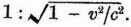
This hypothesis sounds extremely fantastical, for the contraction is not to be looked upon as a consequence of resistances in the ether, or anything of that kind, but simply as a gift from above,—as an accompanying circumstance of the circumstance of motion.
I will now show by our figure that the Lorentzian hypothesis is completely equivalent to the new conception of space and time, which, indeed, makes the hypothesis much more intelligible. If for simplicity we disregard y and z, and imagine a world of one spatial dimension, then a parallel band, upright like the axis of t, and another inclining to the axis of t (see Fig. 1)
represent, respectively, the career of a body at rest or in uniform motion, preserving in each case a constant spatial extent. If OA′ is parallel to the second band, we can introduce t′ as the time, and x′ as the space co-ordinate, and then the second body appears at rest, the first in uniform motion. We now assume that the first body, envisaged as at rest, has the length l, that is, the cross section PP of the first baud on the axis of x is equal to l. OC, where OC denotes the unit of measure on the axis of x; and on the other hand, that the second body, envisaged as at rest, has the same length l, which then means that the cross section Q′Q′ of the second band, measured parallel to the axis of x′, is equal to l. OC′. We now have in these two bodies images of two equal Lorentzian electrons, one at rest and one in uniform motion. But if we retain the original co-ordinates x, t, we must give as the extent of the second electron the cross section of its appropriate band parallel to the axis of x. Now since


it is evident that

If
dx/dt for the second band is equal to
v, an easy calculation gives

therefore also

But this is the meaning of Lorentz’s hypothesis of the contraction of electrons in motion. If on the other hand we envisage the second electron as at rest, and therefore adopt the system of reference
x′ t′, the length of the first must be denoted by the cross section P′P′ of its baud parallel to OC′, and we should find the first electron in comparison with the second to be contracted in exactly the same proportion; for in the figure

Lorentz called the t′ combination of x and t the local time of the electron in uniform motion, and applied a physical construction of this concept, for the better understanding of the hypothesis of contraction. But the credit of first recognizing clearly that the time of the one electron is just as good as that of the other, that is to say, that t and t′ are to be treated identically, belongs to A. Einstein.* Thus time, as a concept unequivocally determined by phenomena, was first deposed from its high seat. Neither Einstein nor Lorentz made any attack on the concept of space, perhaps because in the above-mentioned special transformation, where the plane of x′, t′ coincides with the plane of x, t, an interpretation is possible by saying that the x-axis of space maintains its position. One may expect to find a corresponding violation of the concept of space appraised as another act of audacity on the part of the higher mathematics. Nevertheless, this further step is indispensable for the true understanding of the group Gc, and when it has been taken, the word relativity-postulate for the requirement of an invariance with the group Gc seems to me very feeble. Since the postulate comes to mean that only the four-dimensional world in space and time is given by phenomena, but that the projection in space and in time may still be undertaken with a certain degree of freedom, I prefer to call it the postulate of the absolute world (or briefly, the world-postulate).
III. The representation of motion in the continnum.
The world-postulate permits identical treatment of the four co-ordinates x, y, z, t. By this means, as I shall now show, the forms in which the laws of physics are displayed gain in intelligibility. In particular the idea of acceleration acquires a clear-cut character.
I will use a geometrical manner of expression, which suggests itself at once if we tacitly disregard z in the triplex x, y, z. I take any world-point O as the zero-point of space-time. The cone

with apex 0 (Fig. 2) consists of two parts, one with values

the other with values

The former, the front cone of O, consists, let us say, of all the world-points which "send light to O," the latter, the back cone of O, of all the world-points which "receive light from O." The territory bounded by the front cone alone, we may call "before "O, that which is bounded by the back cone alone, "after" O. The hyperboloidal sheet already discussed

lies after O. The territory between the cones is filled by the one-sheeted hyperboloidal figures

for all constant positive values of k. We are specially interested in the hyperbolas with O as centre, lying on the latter figures. The single branches of these hyperbolas may be called briefly the internal hyperbolas with centre O. One of these branches, regarded as a world-line, would reprosent a motion which, for

and

rises asymptotically to the velocity of light,
c.
If we now, on the analogy of vectors in space, call a directed length in the manifold of x, y, z, t a vector, we have to distinguish between the time-like vectors with directions from O to the sheet

and the space-like vectors
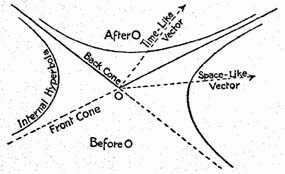 FIG. 2.
with directions from O to

The time axis may run parallel to any vector of the former kind. Any world-point between the front and back cones of O can be arranged by means of the system of reference so as to be simultaneous with O, but also just as well so as to be earlier than O or later than O. Any world-point within the front cone of O is necessarily always before O; any world-point within the back cone of O necessarily always after O. Corresponding to passing to the limit,

there would be a complete flattening out of the wedge-shaped segment between the cones into the plane manifold

In the figures this segment is intentionally drawn with different widths.
We divide up any vector we choose, e.g. that from O to x, y, z, t, into the four components x, y, z, t. If the directions of two vectors are, respectively, that of a radius vector OR from O to one of the surfaces

and that of a tangent RS at the point R of the same surface, the vectors are said to be normal to one another. Thus the condition that the vectors with components
x, y, z, t and
x1,
y1,
z1,
t1 may be normal to each other is

For the measurement of vectors in different directions the units of measure are to be fixed by assigning to a space-like vector from O to

always the magnitude 1, and to a time-like vector from O to

always the magnitude 1/
c.
If we imagine at a world-point P (x, y, z, t) the world-line of a substantial point running through that point, the magnitude corresponding to the time-like vector dx, dy, dz, dt laid off along the line is therefore

The integral

of this amount, taken along the world-line from any fixed starting-point P
0 to the variable end-point P, we call the proper time of the substantial point at P. On the world-line we regard
x, y, z, t—the components of the vector OP—as functions of the proper time
τ; denote their first differential coefficients with respect to
τ by

their second differential coefficients with respect to
τ by

; and give names to the appropriate vectors, calling the derivative of the vector OP with respect to
τ the velocity vector at P, and the derivative of this velocity vector with respect to
τ the acceleration vector at P. Hence, since

we have

i.e. the velocity vector is the time-like vector of unit magnitude in the direction of the world-line at P, and the acceleration vector at P is normal to the velocity vector at P, and is therefore in any case a space-like vector.
Now, as is readily seen, there is a definite hyperbola which has three infinitely proximate points in common with the world-line at P, and whose asymptotes are generators of a "front cone" and a "back cone" (Fig. 3). Let this hyperbola be called the hyperbola of curvature at P. If M is the centre of this hyperbola, we here have to do with an internal hyperbola with centre M. Let ρ be the magnitude of the vector MP; then we recognize the acceleration vector at P as the vector in the direction MP of magnitude c2/ρ.
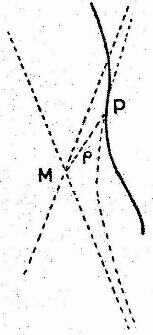 FIG. 3.
If

are all zero, the hyperbola of curvature reduces to the straight line touching the world-line in P, and we must put

IV. The new mechanics.
To show that the assumption of group Gc for the laws of physics never leads to a contradiction, it is unavoidable to undertake a revision of the whole of physics on the basis of this assumption. This revision has to some extent already been successfully carried out for questions of thermodynamics and heat radiation,* for electromagnetic processes, and finally, with the retention of the concept of mass, for mechanics.†
For this last branch of physics it is of prime importance to raise the question—When a force with the components X, Y, Z parallel to the axes of space acts at a world-point P (x, y, z, t), where the velocity vector is

what must we take this force to be when the system of reference is in any way changed? Now there exist certain approved statements as to the ponderomotive force in the electromagnetic field in the cases where the group G
c is undoubtedly admissible. These statements lead up to the simple rule:—When the system of reference is changed, the force in question transforms into a force in the new space co-ordinates in such a way that the appropriate vector with the components

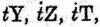
where
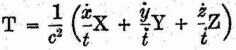
is the rate at which work is done by the force at the world-point divided by c, remains unchanged. This vector is always normal to the velocity vector at P. A force vector of this kind, corresponding to a force at P, is to be called a "motive force vector" at P.
I shall now describe the world-line of a substantial point with constant mechanical mass m, passing through P. Let the velocity vector at P, multiplied by m, be called the "momentum vector" at P, and the acceleration vector at P, multiplied by m, be called the "force vector" of the motion at P. With these definitions, the law of motion of a point of mass with given motive force vector runs thus:—*The Force Vector of Motion is Equal to the Motive Force Vector. This assertion comprises four equations for the components corresponding to the four axes, and since both vectors mentioned are a priori normal to the velocity vector, the fourth equation may be looked upon as a consequence of the other three. In accordance with the above signification of T, the fourth equation undoubtedly represents the law of energy. Therefore the component of the momentum vector along the axis of t, multiplied by c, is to be defined as the kinetic energy of the point mass. The expression for this is

i.e., after removal of the additive constant mc2, the expression

of Newtonian mechanics down to magnitudes of the order 1/
c2. It comes out very clearly in this way, how the energy depends on the system of reference. But as the axis of
t may be laid in the direction of any time-like vector, the law of energy, framed for all possible systems of reference, already contains, on the order hand, the whole system of the equations of motion. At the limiting transition which we have discussed, to

, this fact retains its importance for the axiomatic structure of Newtonian mechanics as well, and has already been appreciated in this sense by I. R. Schütz.
*
We can determine the ratio of the units of length and time beforehand in such a way that the natural limit of velocity becomes

If we then introduce, further,

in place of
t, the quadratic differential expression

thus becomes perfectly symmetrical in x, y, z, s; and this symmetry is communicated to any law which does not contradict the world-postulate. Thus the essence of this postulate may be clothed mathematically in a very pregnant manner in the mystic formula

V. The motion of one and two electrons.
The advantages afforded by the world-postulate will perhaps be most strikingly exemplified by indicating the effects proceeding from a point charge in any kind of motion according to the Maxwell-Lorentz theory. Let us imagine the world-line of such a point electron with the charge e, and introduce upon it the proper time τ from any initial point. In order to find the field caused by the electron at any world-point P1, we construct the front cone belonging to P1 (Fig. 4). The cone evidently meets the world-line, since the directions of the line are everywhere those of time-like vectors, at the single point P. We draw the tangent to the world-line at P, and construct through P1 the normal P1Q to this tangent. Let the length of P1Q be r. Then, by the definition of a front cone, the length of PQ must be r/c. Now the vector in the direction PQ of magnitude e/r represents
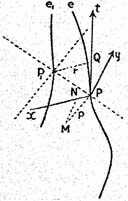 FIG. 4.
by its components along the axes of x, y, z, the vector potential multiplied by c, and by the component along the axis of t, the scalar potential of the field excited by e at the world-point P. Herein lie the elementary laws formulated by A. Liénard and E. Wiechert.*
Then in the description of the field produced by the electron we see that the separation of the field into electric and magnetic force is a relative one with regard to the underlying time axis; the most perspicuous way of describing the two forces together is on a certain analogy with the wrench in mechanics, though the analogy is not complete.
I will now describe the ponderomotive action of a moving point charge on another moving point charge. Let us imagine the world-line of a second point electron of the charge e1, passing through the world-point P1. We define P, Q, r as before, then construct (Fig. 4) the centre M of the hyperbola of curvature at P, and finally the normal BIN from M to a straight line imagined through P parallel to QP1. With P as starting-point we now determine a system of reference as follows:—The axis of t in the direction PQ, the axis of x in direction QP1, the axis of y in direction MN, whereby finally the direction of the axis of z is also defined as normal to the axes of t, x, y. Let the acceleration vector at P be

the velocity vector at P
1 be

The motive force vector exerted at P
1 by the first moving electron
e on the second moving electron
e1 now takes the form
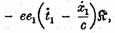
where the components
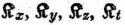
of the vector

satisfy the three relations

and where, fourthly, this vector

is normal to the velocity vector at P
1, and through this circumstance alone stands in dependence on the latter velocity vector.
When we compare this statement with previous formulations* of the same elementary law of the ponderomotive action of moving point charges on one another, we are compelled to admit that it is only in four dimensions that the relations here taken under consideration reveal their inner being in fall simplicity, and that on a three dimensional space forced upon us a priori they cast only a very complicated projection.
In mechanics as reformed in accordance with the world-postulate, the disturbing lack of harmony between Newtonian mechanics and modern electrodynamics disappears of its own accord. Before concluding I will just touch upon the attitude of Newton’s law of attraction toward this postulate. I shall assume that when two points of mass m, m1 describe their world-lines, a motive force vector is exerted by m on m1, of exactly the same form as that just given in the case of electrons, except that + mm1 must now take the place of - ee1. We now specially consider the case where the acceleration vector of m is constantly zero. Let us then introduce t in such a way that m is to be taken as at rest, and let only m1 move under the motive force vector which proceeds from m. If we now modify this given vector in the first place by adding the factor

which, to the order of 1/
c2, is equal to 1, it will be seen
† that for the positions
x1,
y1,
z1, of
m1 and their variations in time, we should arrive exactly at Kepler’s laws again, except that the proper times
τ1 of
m1 would take the place of the times
t1. From this simple remark it may then be seen that the proposed law of attraction combined with the new mechanics is no less well adapted to explain astronomical observations than the Newtonian law of attraction combined with Newtonian mechanics.
The fundamental equations for electromagnetic processes in ponderable bodies also fit in completely with the world-postulate. As I shall show elsewhere, it is not even by any means necessary to abandon the derivation of these fundamental equations from ideas of the electronic theory, as taught by Lorentz, in order to adapt them to the world-postulate.
The validity without exception of the world-postulate, I like to think, is the true nucleus of an electromagnetic image of the world, which, discovered by Lorentz, and further revealed by Einstein, now lies open in the full light of day. In the development of its mathematical consequences there will be ample suggestions for experimental verifications of the postulate, which will suffice to conciliate even those to whom the abandonment of old-established views is unsympathetic or painful, by the idea of a pre-established harmony between pure mathematics and physics.
NOTES
by A. SOMMERFELD
* An application of this fact in its essentials has already been given by W. Voigt, Göttinger Nachrichten, 1887, p. 41.
* A. Einstein, Ann. d. Phys., 17, 1905, p. 891; Jahrb. d. Radioaktivität und Elektronik, 4, 1907, p. 411.
* M. Planck, "Zur Dynamik bewegter Systeme," Berliner Berichte, 1907, p. 542; also in Ann. d. Phys., 26, 1908, p. 1.
† H. Minkowski, "Die Grundgleichungen fur die elektromagnetischen Vorgänge in bewegten Körpern," Göttinger Nachrichten, 1908, p. 53.
* H. Minkowski, loc. cit., p 107. Cf. also M. Planck, Verhandlungen der physikalischen Gesellschaft, 4, 1906, p. 136.
* I. R. Schütz, "Das Prinzip der absoluten Erhaltung der Energie," Göttinger Nachr., 1897, p. 110.
* A. Liénard, "Champ électrique et magnétique produit par une charge concentrée en un point et animée d’un mouvement quelconque," L′Eclairage Electrique, 16, 1898, pp. 5, 53, 106; E. Wiechert, "Elektrodynamische Elementargesetze," Arch. Néerl. (2), 5, 1900, p. 549.
* K. Schwarzwald, Göttinger Nachr., 1903, p. 132; H. A. Lorentz, Enzykl. d. math. Wissensch., V, Art. 14, p. 199.
† H. Minkowski, loc. cit., p. 110.
* Sommerfeld seems to take ct as a co-ordinate in the graph in place of t as used by Minkowski.—TRANS.