Mathematics
Hilbert on Dirichlet’s Principle
1
Dirichlet’s principle is an argument which Dirichlet, motivated by an idea of Gauss, applied to the solution of the so-called boundary value problem, and which may be briefly characterized as follows. Let perpendiculars be erected on the xy-plane, at the points of the given boundary curve, and project the boundary values in question on these. Among the surfaces

bounded by the space curve formed in this way, let a surface be chosen for which the value of the [Dirichlet] integral

is a minimum. As one easily shows by the calculus of variations, this surface is necessarily the graph of a harmonic function ["eine Potentialfläche"]. By appealing to a consideration of this kind, Riemann2 considered the proof of the existence of a solution of the boundary value problem as settled, and then unhesitatingly based his magnificent theory of Abelian functions on this.
It was first recognized by Weierstrass that the Dirichlet principle is not a valid method of proof ["Schlussweise"] here: indeed, if only a finite number of numerical values is given, we can immediately conclude that there is a least number among them; [but] an infinite set of numbers need not contain a smallest member. Rather, a special proof is required to show that in the case discussed there actually exists a surface

for which the corresponding value of the integral
J(
f) is a minimum.
The important investigations by C. Neumann, H. A. Schwarz, and H. Poincaré (73) have shown that under certain very general assumptions on the nature of the boundary curve and the boundary values, the boundary value problem is certainly solvable, and thereby the existence of that minimizing function f(x, y) is assured, conversely.
The Dirichlet principle owes its fame to the attractive simplicity of its basic mathematical idea, the unquestionable richness of the possible applications to pure and physical mathematics, and its convincing nature. But since Weierstrass’s criticism, the Dirichlet principle has found only historical interest and seemed finished, at least as a method for solving the boundary value problem. C. Neumann has stated regretfully that the Dirichlet principle, so beautiful and once so widely applied, now seems to have passed away forever; only A. Brill and M. Noether arouse new hope in us by expressing the conviction that the Dirichlet principle, in some sense modeled after nature, may perhaps be revived in a modified form.
The following is an attempt to revive the Dirichlet principle.
Considering that Dirichlet’s problem is only a special problem of the calculus of variations, we arrive at a statement of the Dirichlet principle in the following more general form:
Every problem of the calculus of variations has a solution, provided restrictive assumptions appropriate to the nature of the given boundary conditions are fulfilled, and, when necessary, the concept of the solution has undergone an appropriate extension.
The following two examples show how this principle can serve as guiding star for finding rigorous and simple existence proofs:
I. To draw the shortest line between two given points P and P(1)on a given surface

Let l be the lower bound for the lengths of all curves on the surface between the two given points. From the totality of such connecting curves we select curves

whose respective lengths

approach the limit
l. On
C1 we measure off the length

from
P, and thus obtain the point

on
C1; then we measure off the length

from
P on
C2 to

further, the length

from
P on

etc. Let the points

have the point

as a point of accumulation, where

is again a point of the surface

The same procedure which we have just applied to the points P and P(1), and which led us to a point

is now applied to the points
P and

and thus we arrive at a point

on the given surface. Similarly, if we apply the indicated procedure to the points

and
P(1) we obtain a point

Correspondingly, we find the points

All of these points and their limit points ["Verdichtungsstellen"] form a continuous curve on the surface

which is the desired shortest line.
The proof of this fact is easily carried through by defining the length of the curve as the limit of the lengths of inscribed polygons. As we see at the same time, it suffices to assume that the given function f(x, y) and its first derivatives with respect to x and y are continuous.
II. A harmonic function
 is to be found which assumes given boundary values on a curve in the xy-plane
.
For simplicity, let. us assume that the given boundary curve has a continuous tangent and curvature, and that the boundary values are continuous and differentiable. We next construct the space curve mentioned at the beginning of this essay, and then determine a fixed angle φ . . . with the following property: if

is any analytic or piecewise analytic surface whose boundary is formed by the space curve, then from

a surface

can always be constructed in such a way that the value of the integral
3

associated with

is less than or equal to the value of the integral
J(
F) associated with

and at the same time

nowhere has a tangent which makes an angle larger than φ with the
xy-plane. One arrives at such an angle [φ] by inspecting those points where the slope of the surface

(i.e., arctan

exceeds a certain quantity, and showing that the surface

in the neighborhood of these points can always be replaced by a piece of the plane

or (at the boundary) by a piece of a funnel-shaped potential surface
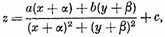
where a, b, c, α, and β are such constants that the plane, resp. the tangents of the particular piece of the funnel-shaped potential surface are inclined less steeply toward the xy-plane.
Let k be the infimum ["untere Grenze"] of the integrals J taken over all surfaces bounded by the given space curve. From the totality of these surfaces we select [a sequence of] surfaces

the values of whose [Dirichlet] integrals

approach the limit k. Then we replace [these] surfaces

by surfaces

respectively [constructed as above], whose tangent planes nowhere make an angle larger than φ with the xy-plane.
From the sequence of functions

we now select a subsequence of functions

such that the limit ["Grenzwert"]

exists for all those points x, y within the given boundary [plane] curve whose coordinates x, y are rational numbers. Since . . . for all points inside the boundary [curve]
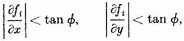
it follows easily that the sequence of functions

converges uniformly in the interior of the curve, including the boundary; i.e.,

is a continuous function of the variable x and y.
The surface

is the desired potential surface. The proof of this presents no difficulty; it goes through most simply if we use the existence of the minimal function, that is, the solution of the boundary value problem for the circle and an arbitrary continuous boundary function; but the proof may also be given directly.
Aside from the simplicity and transparency of the method of proof ["Schlussweise"] briefly sketched here, . . . the main advantage of the new method is the fact that it uses only the minimum property and makes no use of the special nature of the problem, i.e., of the special properties of the geodesic line or the potential function; the procedure therefore is applicable also to more general problems of the theory of surfaces and of mathematical physics.
1 D. Hilbert, "Ueber das Dirichlet’sche Prinzip," Jahresb. Deut. Math. Ver. 8 (1900), 184–188.
2 "Grundlagen" (1851), Werke, 2nd ed., 30, and "Theorie der Abel’schen Functionen" (1857), Werke, 2nd ed., 105. (D. H.) [Cf. Selections 14 and 39a.]
3 Clearly, J is the Dirichlet integral of (1).