Walter Baade "The Resolution of M 32, NGC 205, and the Central Region of the Andromeda Nebula," Astrophysical Journal 100 137–146 1944
Types of Star Population
By Walter Baade
In contrast to the majority of the neublae1 within the local group of galaxies1 which are easily resolved into stars on photographs with our present instruments, the two companions of the Andromeda nebula—Messier 32 and NGC 205—and the central region of the Andromeda nebula itself have always represented an entirely nebulous appearance. Since there is no reason to doubt the stellar composition of these unresolved nebulae—the high frequency with which novae occur in the central region of the Andromeda nebula could hardly be explained otherwise—we must conclude that the luminosities of their brightest stars are abnormally low, of the order of

or less compared with

for the brightest stars in our own galaxy and for the resolved members of the local group. Although these data contain the first clear indication that in dealing with galaxies we have to distinguish two different types of stellar populations, the peculiar characteristics of the stars in unresolved nebulae remained, in view of the vague data available, a matter of speculation; and, since all former attempts to force a resolution of these nebulae had ended in failure, the problem was considered one of those which had to be put aside until the new 200-inch telescope should come into operation.
It was therefore quite a surprise when plates of the Andromeda nebula, taken at the 100-inch reflector in the fall of 1942, revealed for the first time unmistakable signs of incipient resolution in the hitherto apparently amorphous central region—signs which left no doubt that a comparatively small additional gain in limiting magnitude, of perhaps 0.3–0.5 mag., would bring out the brightest stars in large numbers.
How to obtain these few additional tenths in limiting magnitude was another question. Certainly there was little hope for any further gain from the blue-sensitive plates hitherto used, because the limit set by the sky-fog, even under the most favorable conditions, had been reached. However, the possibility of success with red-sensitive plates remained.
From data accumulated in recent years it is known that the limiting red magnitude which can be reached on ammoniated red-sensitive plates at the 100-inch in reasonable exposure times is close to

the limiting photographic magnitude being

These figures make it clear at once that stars beyond the reach of the blue-sensitive plates can be recorded in the red only if their color indices are larger than +1.0 mag.—the larger, the better. Now there are good reasons to believe that the brightest stars in the unresolved early-type galaxies actually have large color indices. When a few years ago the Sculptor and Fornax systems were discovered at the Harvard Observatory, Shapley introduced these members of the local group of galaxies as stellar systems of a new kind.
2 Shortly afterward, however, Hubble and the writer pointed out that in all essential characteristics, particularly the absence of highly luminous O- and B-type stars, these systems are closely related to the unresolved members of the local group.
3 It was therefore suggested that in dealing with the Sculptor and Fornax systems "we are now observing extragalactic systems which lack supergiants and are yet close enough to be resolved." Since the brightest stars in the Sculptor system, according to later observations by the present writer, have large color indices (suggesting spectral type K), it appeared probable that this would hold true for the brightest stars in the unresolved members of the Andromeda group. Altogether there was good reason to expect that the resolution of these systems could be achieved with the 100-inch reflector on fast red-sensitive plates if every precaution were taken to utilize to the fullest extent the small margin available in the present circumstances.
Since success depended so much upon a careful use of the available light-intensities, it may be surprising that the final tests were made in the light of the narrow band λλ6300–6700 (on ammoniated Eastman 103E plates behind a Schott RG 2 filter). The reason is the following: It is quite true that nearly twice the speed in the red could have been obtained if a yellow filter, transmitting wave lengths

had been used instead of the red filter. But experience has shown that the benefits to be derived from the larger range of wave lengths are of doubtful value, particularly in long exposures, because the larger range includes two of the strongest emission lines of the night sky—the green aurora line at λ5577 and the red [OI] doublet λ6300, λ6364.
The red doublet at λ6300, λ6364 has proved to be especially troublesome for astronomical photography, partly because it falls into the region of maximum sensitivity of the E plates, partly because it displays erratic intensity changes from night to night and even in the same night. These changes are large, and it is well known that not infrequently, partly at the times of sunspot maxima, the intensity of the red doublet surpasses that of the strong green line by a factor of 2 or more. Consequently, it is impossible to predict whether on a given night the exposure time for the range λλ5000–6700 has to be restricted to 1 hour or can be safely extended to several hours. To avoid any difficulties resulting from uncontrolled sky fog, which are especially serious for objects near the plate limit, it was decided to use the narrower range of wave lengths cut out by the RG 2 filter. Although this filter transmits about 24 per cent of the red doublet, no difficulties have thus far been encountered even with exposure times up to 9 hours. It may be remarked here that the plates to be discussed later are practically free from sky fog.
The minimum exposure times required with the RG 2 filter turned out to be 4 hours. Exposures of this length with a large reflector present a number of problems if critical definition is the prime requisite. That only nights with exceptionally fine definition, together with a practically perfect state of the mirror, would do hardly needs mention. Fortunately, these conditions are easily met on Mount Wilson during the fall months when the Andromeda region is in opposition. But real difficulties were presented by changes of focus during the relatively long exposures. On account of the normal drop in temperature during the night these changes are quite large under average conditions; hence repeated refocusing with the knife edge—usually once every hour—is necessary as the exposure proceeds. Although a special, precision-built plateholder arrangement is available for such purposes, its manipulation is always somewhat risky because the change from the field to a suitable focus star and back has to be made in complete darkness. Even if such repeated manipulations are performed without mishap during a prolonged exposure, the method remains a makeshift, since between two settings the plate will gradually move out of focus. To avoid both difficulties it seemed best to use only nights on which the focus-changes at the 100-inch are very small if not entirely negligible. Such conditions are not infrequently met on Mount Wilson during the fall, when, owing to a temperature inversion, the temperature stays practically constant all night. Neither was it difficult in the present case to select the proper nights. Since in the fall the Andromeda region culminates around midnight, a careful watch of the state of the mirror and of the temperature in the early evening hours permits a fair prediction of the focus-changes during the latter part of the night. Eventual small changes in focus during the exposure can then be inferred from changes in the coma of the guiding star. Although this method has fallen into disrepute because of some bad experiences of earlier observers, the writer has found it as good as the knife-edge test if the following conditions are fulfilled: (1) a nearly perfect figure of the mirror: (2) steady and crisp images; and (3) such an adjustment of the guiding eyepiece that small focus-changes produce marked changes in the coma pattern of the guiding star. All exposures discussed in the following pages have been made in this manner. As a control of the correct handling of the focus-changes, the focus was checked with the knife edge at the end of each exposure. In every case the difference between the last actually used focus and the knife-edge setting was well below 0.1 mm.
The plates of the Andromeda nebula, of Messier 32, and of NGC 205, taken in this manner at the 100-inch reflector during the fall months of 1943, led to the expected results. All three systems were resolved into stars. A description of the plates thus far obtained follows. Since the preparation of adequate reproductions would involve time-consuming experiments impossible under present conditions, illustrations will be published later. The plate of NGC 185 in the following Contribution will give the reader an idea how far the resolution of the hitherto unresolved systems of the local group has been successful.
I. Messier 32, the brighter, round companion of the Andromeda nebula (ammoniated 103E plate behind Schott RG 2 filter, λλ6300–6700; exposure 3h30m; August 25, 1943).—The plate was obtained under ideal conditions: a perfect mirror, seeing 5–6, and no change in focus during the whole exposure (which was cut short by the oncoming twilight). As a result, the smallest stellar images on the plate have diameters of less than 0.7" of arc.
The central part of Messier 32 is completely burned out, but the outer parts have disintegrated into an unbelievable mass of the faintest stellar images. The plate is of special interest because it shows in an instructive manner which features are the first signs of resolution in systems of this type. They are star chains, formed by accidental groupings of some of the brightest members of the system. Clearly resolved into stars on the red exposure, they were indicated on the best blue-sensitive plates taken previously, where they appear as very weak, ill-defined filaments in the otherwise amorphous structure of the nebula.
The extent of Messier 32—i.e., the distance to which its members can be traced—is difficult to ascertain, since a spiral arm of the Andromeda nebula sweeps over the field in such a way that at greater distances from the center of Messier 32 the members of both systems are hopelessly mixed. But there are indications that the situation is even more complicated. To gain more intensity, another 4-hour exposure of Messier 32 was made on August 26, 1943, this time behind a Schott GG 11 filter, so that the plate covered the range from λ5000 to λ6700. It so happened that the sky began to brighten up after the exposure was started—probably on account of a diffuse aurora—with the result that the plate fog became rather dense. The plate is interesting, however, because it shows that up to a distance of 17′ south of Messier 32 the field is covered with a stratum of extremely faint stars. Obviously these stars belong to the Andromeda nebula, since their slowly decreasing density in a southward direction follows the contour lines of the nebula. There seems to be little doubt that this mass of faint stars, in luminosity and color index similar to the brightest stars in Messier 32, is identical with the faint extension of the Andromeda nebula first recorded photo-electrically by Stebbins and Whitford.4 On the plate just mentioned the stars can be traced along the minor axis of the Andromeda nebula to a distance of 32′ from the center, corresponding to the isophote 25.4 mag. per square second of arc (Stebbins and Whitford). Properly centered plates may well shift the limit farther out to lower isophotes.
II. NGC 205, the fainter elliptical companion of the Andromeda nebula (ammoniated 103E plate behind Schott RG 2 filter, λλ6300–6700; exposure 4 hours, September 29, 1943).—During the 4-hour exposure thin haze occasionally drifted over the field, probably reducing the effective exposure time to

hours. The plate was taken under excellent seeing conditions, but with a fast-deteriorating figure of mirror caused by rising temperatures. As a result the otherwise small and crisp images show an irregular flare which may have reduced both resolving-power and limiting magnitude. In spite of these shortcomings, NGC 205 is beautifully resolved up to the very nucleus. It is a much looser aggregration of stars than Messier 32, as was to be expected from its lower surface brightness.
In order to test how far the faint stars revealed on the red exposures are reproduced from one plate to another, a second plate of NGC 205, of only 90 minutes exposure, was obtained in the larger range λλ5000–6700 on December 23, 1943. This shorter exposure registers stars as faint as the earlier 4-hour exposure behind the RG 2 filter. The intercomparison of the two plates in the blink comparator showed that the pattern of resolution is identical on both plates, each configuration of faint stellar images on one plate being reproduced on the other. Undoubtedly, a small percentage of the images are still unresolved doubles and accidental groupings of stars, but the majority are certainly single stars. Intercomparison of the two plates led to the discovery of 3 faint variable stars which are undoubtedly members of NGC 205.
Nebulae of the globular type like NGC 205 have always presented the difficulty that their dimensions, as inferred from the extent of the nebulosity, were rather indeterminate. With the resolution of NGC 205 it has become possible to use a definition of the radius which has proved both significant and practical for globular clusters. The radius is defined as the maximum distance from the center up to which the members can be traced. The dimensions of NGC 205 derived in this manner are

The only comparable value is that published by Reynolds,
5 who derived

from photometric measures on a plate taken with the Helwan reflector. Reynolds’ value should be considered as a lower limit, since his plate was exposed for only 30 minutes.
Because the resolution of NGC 205 proved so easy in red light, a corresponding test on a fast blue-sensitive plate seemed to be of special interest. The nebula was therefore photographed at the 100-inch on the remarkably fast Eastman 103a-O emulsion. The exposure time was 90 minutes, which represents about the practical limit for plates of this type. The plate reveals incipient resolution of NGC 205 quite unmistakably; but the prevailing pattern is still very soft, and the smallest elements are not yet stars but small-scale fluctuations in the stellar distribution. The resulting impression is very irritating to the eye. The nebulosity has lost its amorphous character, but nothing definite has yet emerged.
III. The inner amorphous region of the Andromeda nebula (ammoniated 103E plate behind a Schott RG 2 filter, λλ6300–6700; exposure 4 hours, September 28, 1943).—The plate was taken under excellent conditions: a perfect mirror, seeing 3–6, focus-changes during the whole 4-hour exposure amounting to less than 0.1 mm. Since it was to be expected that the nuclear region of the nebula would be burned out in a 4-hour exposure, the plate was centered on a point of the preceding major axis, 11′ distant from the nucleus. It shows the hitherto amorphous nebulosity disintegrated into a dense sheet of extremely faint stars, all close to the limit of the plate. As expected, the resolution decreases somewhat in the denser parts of the nebulosity but is easily traced to a point 3’.5 from the nucleus where the burnt-out area sets in. Altogether, there is not the slightest doubt that with the proper optical means the Andromeda nebula is resolvable into stars right up to the very nucleus.
The main facts presented in the preceding descriptions can be summarized in the following four statements:
1. By using red-sensitive plates we have recorded the brightest stars in the hitherto unresolved members of the local group of galaxies.
2. The apparent magnitudes of the brightest stars are closely the same in all three systems, a result which was to be expected because the three nebulae form a triple system.
3. At the upper limit of stellar luminosity, stars appear at once in great numbers in these systems. (In what have been termed the resolvable systems, the brightest stars increase very slowly in numbers for the first 1.0–1.5 mag. below the upper limit of luminosity.)
4. With our present instruments early-type nebulae can be resolved on red-sensitive plates if their distance modulus does not exceed that of the Andromeda group. . . .
With these data at hand we are in the position to draw an important conclusion regarding the Hertzsprung-Russell diagram of the stars in early-type nebulae. As pointed out earlier, it has been known for some time that the highly luminous stars of the main branch (O- and B-type stars), together with the supergiants of types F-M, are absent in these systems; in fact, their absence was the reason why up to now the early-type nebulae have proved to be unresolvable. But neither are the brightest stars which we find in them the common giants of the ordinary H-R diagram, because as a group they are nearly 3 mag. brighter (the average early K-type giant of the H-R diagram has the absolute photographic magnitude

compared with

for the mean absolute magnitude of the brightest stars in the early-type nebulae).
It is significant that the same situation is known to exist in the globular clusters. Table 1 serves to illustrate this point. It gives M25—the mean absolute photographic magnitude of the 25 brightest stars in a globular cluster—as a function of Mt, the total brightness (stellar content) of the cluster. Only clusters with distance moduli determined from cluster-type variables have been used. Table 2 shows that for the richest globular clusters M25 is -1.3, compared with

for the brightest stars in NGC 205. Now
M25 in globular clusters and our mean value for the brightest stars in NGC 205 should be closely comparable; for although the value for NGC 205 refers to the several hundred of its brightest stars, it should define nearly the same group of stars as
M25 in the clusters, because the population of NGC 205, according to its luminosity, exceeds that of the richest globular clusters by a factor to to 20. The agreement of the values quoted above is therefore as good as one could expect.
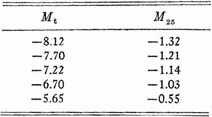 TABLE 1. Data for Globular Clusters
Similarly, there is perfect agreement in the color indices of the brightest stars in early-type nebulae and globular clusters. We derived

mag. for the brightest stars in NGC 205, a value identical with that found by H. Shapley in globular clusters.
6
We conclude, therefore, that, within the present uncertainties, absolute magnitude and color index of the brightest stars in early-type nebulae are the same as those of the brightest stars in globular clusters. However, the similarity of the stellar populations of early-type nebulae and globular clusters does not end here; for there are strong indications that another, even more unique feature of the H R diagram of the globular clusters is shared by the stars of the early-type nebulae.
Figure 1 represents schematically the H-R diagrams of the stars in the neighborhood of the sun (shaded) and of those in globular clusters (hatched).7 To conform with the usual practice, photovisual magnitudes have been used for the absolute magnitudes; hence the brightest stars in globular clusters appear now as stars of

Both the dispersion and the frequency of the stars have been roughly indicated to convey an idea of the distribution of the two groups of stars in the H-R plane.
As already remarked, the H-R diagram for globular clusters begins with early K-type stars of

On its downward slope the giant branch soon splits into two separate branches, the one continuing more or less in the original direction, the other proceeding nearly horizontally from spectral type G through F and A into the early B’s. For our following argument we are concerned with this horizontal branch of the cluster diagram, which is remarkable for two reasons: (1) it sweeps through the well-known Hertzsprung gap of the ordinary H-R diagram; or, to put it differently, stellar states which seem to be excluded in the ordinary H-R diagram for galactic stars in our neighborhood are quite frequent in the H-R diagram of the globular clusters; (2) the short-period Cepheids, which are such a characteristic feature of the globular clusters, are located along this horizontal branch of the cluster diagram.
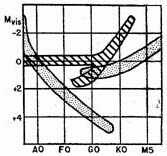 Fig. 1. The spectrum (color)-luminosity diagram: for stars in the solar neighborhood (shaded) and in globular clusters (hatched). Ordinates are provisional absolute magnitudes.
In a very interesting paper M. Schwarzschild8 has recently shown that, if the mean absolute magnitudes and the mean color indices of the short-period Cepheids in a cluster are used as co-ordinates, their domain is restricted to a well-defined, exceedingly narrow strip within the horizontal branch. More than that, Schwarzschild produces excellent evidence that any cluster star located within this strip is actually a cluster-type variable. This suggests the following interpretation: Since the short-period Cepheids are localized in a well-defined, narrow strip of the H-R plane, they can be expected in considerable numbers only in stellar populations which possess a high density in this particular region of the H-R plane. This condition is fulfilled by the H-R distribution of the stars in globular clusters. It is not fulfilled by the stars in the solar neighborhood (the slow-moving stars) because their distribution exhibits the Hertzsprung gap. . . .
We thus have two strong arguments which indicate that the H-R diagrams of globular clusters and of early-type nebulae are similar, if not identical:
1. In both populations the brightest stars are K-type stars of


2. In both populations the distribution in the H-R plane is characterized by high density in the Hertzsprung gap, with the resulting appearance of cluster-type variables.
But we can advance a third argument which explains at the same time why the globular clusters happen to be the prototypes of this peculiar type of stellar population which we will call type II in distinction from populations defined by the ordinary H-R diagram—type I. This is the fact that, as far as the present evidence goes, globular clusters are always associated with stellar populations of type II. A good example is our own galaxy, where the globular clusters clearly have the same spatial distribution as the cluster-type variables which are representative of the stars of the second type. It is also significant that among the nebulae composed solely of stars of type II even the absolutely faintest usually have one or two globular clusters. Examples are NGC 205, the Fornax system, and the two faint globular nebulae NGC 147 and NGC 185, discussed in the following paper. This association suggests that globular clusters are properly regarded as condensations in stellar populations of the second type. Under these circumstances it is hardly surprising that their H-R diagram should be essentially identical with that of the larger populations of which they are members.9
Although the evidence presented in the preceding discussion is still very fragmentary, there can be no doubt that, in dealing with galaxies, we have to distinguish two types of stellar populations, one which is represented by the ordinary H-R diagram (type I), the other by the H-R diagram of the globular clusters (type II) (see Fig. 1). Characteristic of the first type are highly luminous O- and B-type stars and open clusters; of the second, globular clusters and short-period Cepheids. Early-type nebulae (E-Sa) seem to have populations of pure type II. Both types co-exist, although differentiated by their spatial arrangement, in the intermediate spirals like the Andromeda nebula and our own galaxy.10 In the late-type spirals and in most of the irregular regular nebulae the highly luminous stars of type I are the most conspicuous feature. It would probably be wrong, however, to conclude that we are dealing with populations of pure type I, because the occurrence of globular clusters in these late-type systems, for instance, in the Magellanic Clouds, indicates that a population of type II is present too. Altogether it seems that, whereas stars of the second type may occur alone in a galaxy, those of type I occur only in association with type II.
1 [The words "galaxy" and "nebula" are used interchangeably in this article. "Early type" nebulae are the ellipsoidal galaxies, E0 to E7 in Hubble’s classification.]
2Nature 142, 715 (1938); Proc. Nat. Acad. 25, 565 (1939).
3Pub. A.S.P. 51, 40 (1939).
4Proc. Nat. Acad. 20, 93 (1934).
5Mon. Not. Roy. Ast. Soc. 94, 519 (1933–1934).
6Star Clusters (Harvard Observatory Monographs No. 2; McGraw-Hill, New York, 1930), p. 29.
7 [Compare Fig. 3 in selection 43 above.]
8Harv. Circ., No. 438 (1940).
9 Similarly, we should regard the open clusters as condensations in populations of type I, an interpretation which hardly needs comment in view of the intimate association of open clusters and slow-moving stars in our own galaxy. It is the more acceptable because it would ascribe the curious variations in the composition of open clusters (Trumpler’s types) to the large-scale variations in the composition of populations of type I which have been noted not only in our own galaxy but also in several of the nearer extragalactic systems.
10 The strong concentration of both globular clusters and short-period Cepheids toward the center of our galaxy indicates that the main mass of the stars of type II is located in this region, which, in turn, suggests a structure of our galaxy very similar to that of the Andromeda nebula.